Guide: welding thin sheet metal and auto body panels without burn-through or warping
On 0.6 to 2 mm sheet, a hole opens in a split second and warping shows up as the panel cools. This guide takes the job in shop order, with the values published by wire and machine makers, TWI and the collision repair training body I-CAR, each with its source.
PDF, 25 A4 pagesInstant download · see the pages
Includes:
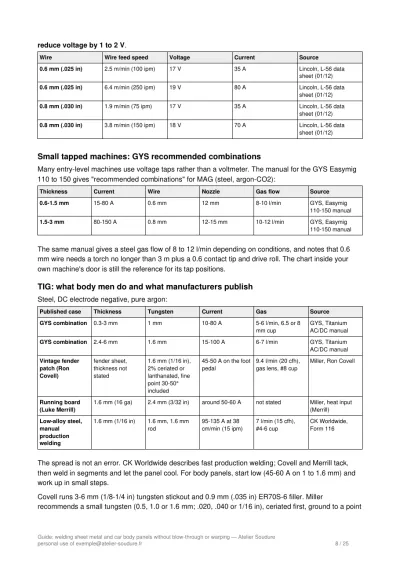
- Manufacturer MIG settings for 0.6–2 mm (24–14 ga) from Hobart, Lincoln and GYS, plus TIG settings for body panels, each line sourced
- Distortion control: tight fit-up, tacks 25 mm (1 in) apart, tack sequences, stitch welding and cooling
- Plug welds by the numbers (8 mm hole, 10–13 mm plug) and a destructive test
- MIG brazing galvanized sheet with CuSi3: gap, current, keeping the zinc
- A 12-step panel patch, hammer-and-dolly and heat shrinking, troubleshooting table, printable shop chart
Preview
Real pages of the PDF (the buyer's email address is printed on the cover).
In pictures
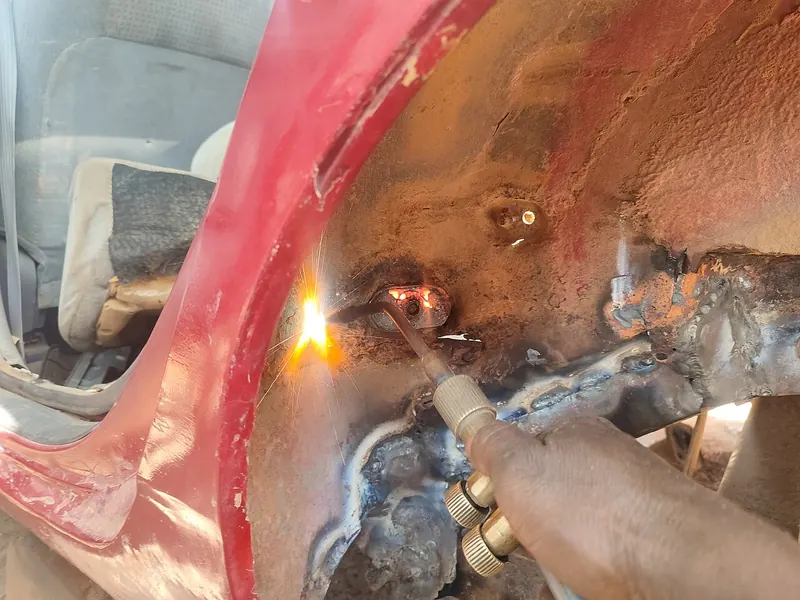
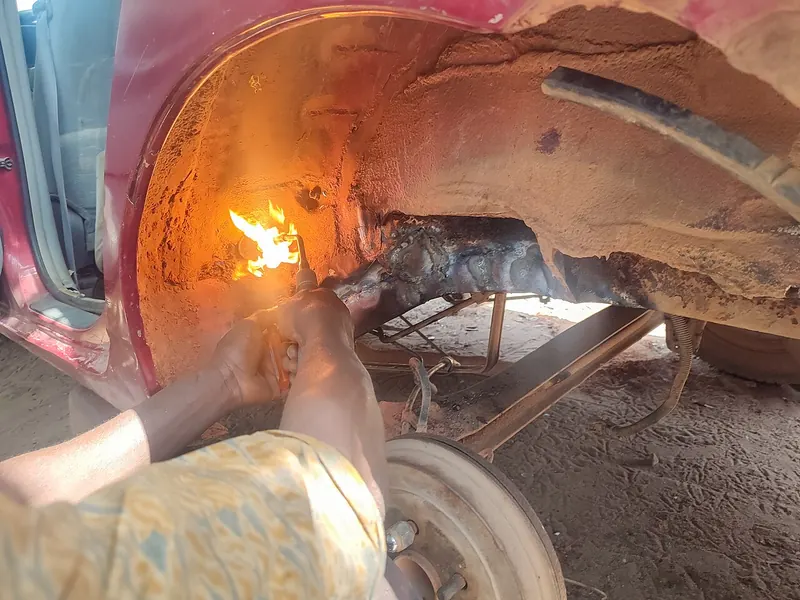
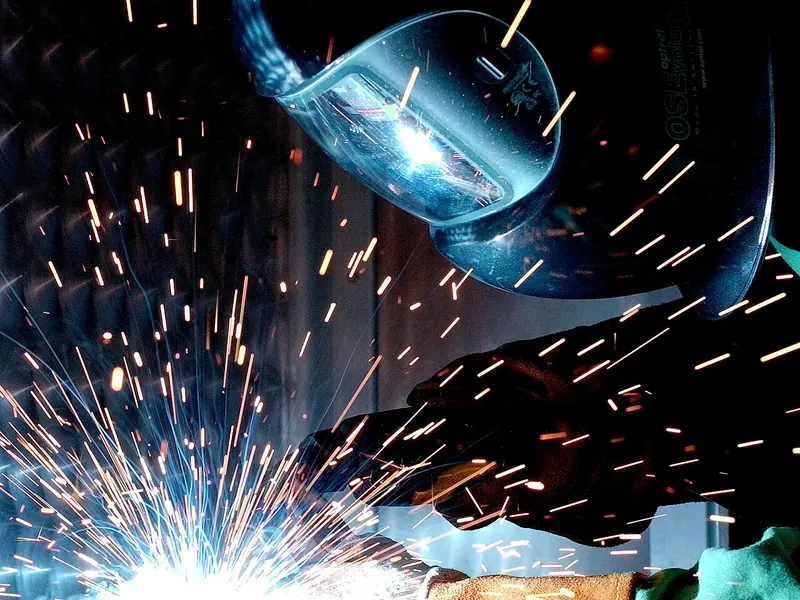
Illustrative photos, published by their authors under free licences.
What you get
- MIG settings for 0.6–2 mm (24–14 ga) from Hobart, Lincoln and GYS, including tapped small machines, plus TIG settings for body panels, each line sourced.
- Distortion control: tight fit-up, tacks 25 mm (1 in) apart, three tack sequences, stitch welding, backstep and cooling.
- Plug welds by the numbers (8 mm / 5/16 in hole, 10–13 mm plug, 3 mm / 1/8 in maximum height) and a destructive test on offcuts.
- MIG brazing galvanized sheet with CuSi3: gap, current, keeping the zinc, and when not to use it.
- Straightening with hammer and dolly and heat shrinking, then a 12-step panel patch.
- A troubleshooting table, shop safety specific to car work (fuel, foams, electronics, airbags), a printable chart and a settings log.
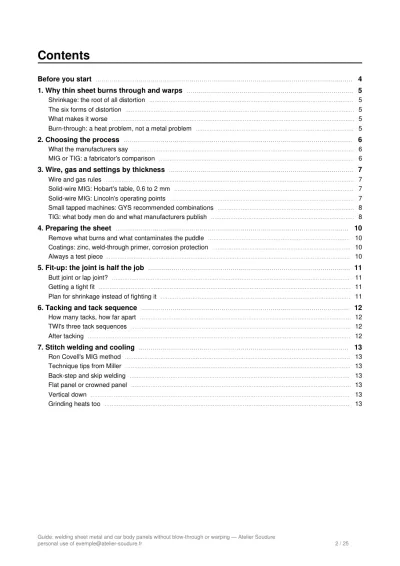
Contents
- Before you start p. 4
- 1. Why thin sheet burns through and warps p. 5
Shrinkage: the root of all distortion · The six forms of distortion · What makes it worse · Burn-through: a heat problem, not a metal problem - 2. Choosing the process p. 6
What the manufacturers say · MIG or TIG: a fabricator's comparison - 3. Wire, gas and settings by thickness p. 7
Wire and gas rules · Solid-wire MIG: Hobart's table, 0.6 to 2 mm · Solid-wire MIG: Lincoln's operating points · Small tapped machines: GYS recommended combinations · TIG: what body men do and what manufacturers publish - 4. Preparing the sheet p. 10
Remove what burns and what contaminates the puddle · Coatings: zinc, weld-through primer, corrosion protection · Always a test piece - 5. Fit-up: the joint is half the job p. 11
Butt joint or lap joint? · Getting a tight fit · Plan for shrinkage instead of fighting it - 6. Tacking and tack sequence p. 12
How many tacks, how far apart · TWI's three tack sequences · After tacking - 7. Stitch welding and cooling p. 13
Ron Covell's MIG method · Technique tips from Miller · Back-step and skip welding · Flat panel or crowned panel · Vertical down · Grinding heats too - 8. Plug welds in place of spot welds p. 14
What they are for · I-CAR's published dimensions · Making a plug weld, step by step - 9. MIG brazing galvanized sheet with CuSi3 wire p. 15
The principle · What it offers, and its limits · I-CAR's rules for collision repair · Technique - 10. Straightening after welding p. 16
Stretching with hammer and dolly · Heat correction: TWI's method - 11. Replacing a section of panel, start to finish p. 17
The steps - 12. Troubleshooting p. 18
- 13. Safety specific to auto body work p. 19
- 14. What belongs with a professional p. 20
- 15. Checklists and logbook p. 21
Before buying · On the day · After · Settings logbook - 16. The chart for the shop wall p. 22
- 17. Glossary p. 23
- Sources p. 24
Contents read from the PDF that is sold (25 A4 pages), with the page number of each chapter.
Who it is for
Restorers replacing a lower fender or door skin on a classic car, farmers and hobbyists fixing machine hoods, enclosures and non-structural trailer sheet, and apprentices moving from thick steel to sheet.
What this guide is not
It is not a vehicle maker's repair procedure: on a modern car, that procedure comes first, and structural parts belong with a collision repairer. Metric values first, with inches and gauge in brackets where the source is American.
Guide: welding sheet metal and car body panels without blow-through or warping — €19 incl. VAT
Welding 0.6–2 mm sheet without burn-through or warping: manufacturer MIG and TIG settings, fit-up, tacking, stitch welding, plug welds, CuSi3 MIG brazing of galvanized steel and a step-by-step panel patch. Vehicle structure and safety parts belong with a collision repairer; the maker's procedure comes first.