Guide: welding stainless steel, grades, filler, settings and pickling
Stainless steel welds easily. What goes wrong is what comes after: a blue weld that rusts in its first winter, a rail speckled with orange after a carbon-steel brush, a warped tank. This guide takes each step in shop order, with the values published by filler and machine makers and by welding institutes.
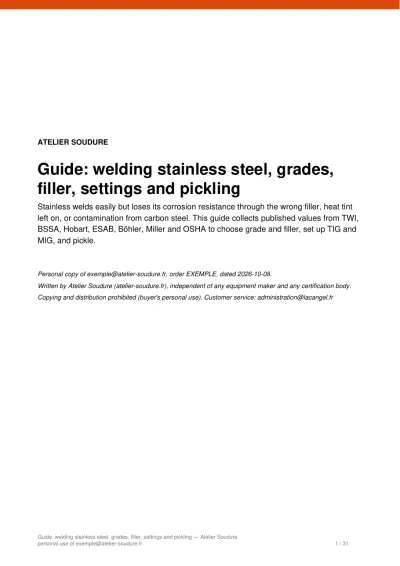
PDF, 31 A4 pagesInstant download · see the pages
Includes:
- Compositions of the common grades to EN 10088-2:2024, with their 304/316/430/2205 equivalents
- Filler selection (308L, 316L, 309L for stainless to mild steel) and why: 5–10% ferrite in the weld
- Manufacturer TIG and MIG settings, metric first with inches, cfh and ipm, a source on every line
- Heat tint chart and step-by-step pickling, with hydrofluoric acid first aid
- Troubleshooting table, four worked cases, checklists, a one-page wall chart and the OSHA Cr(VI) limits
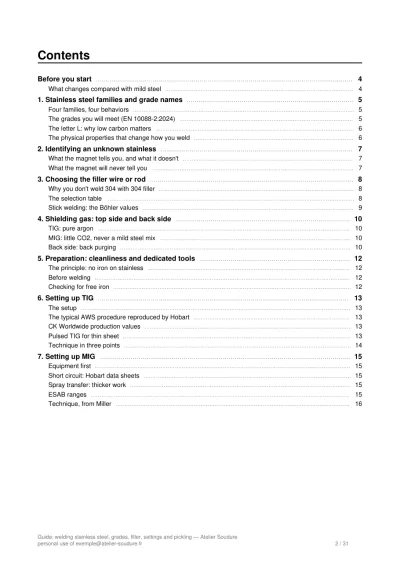
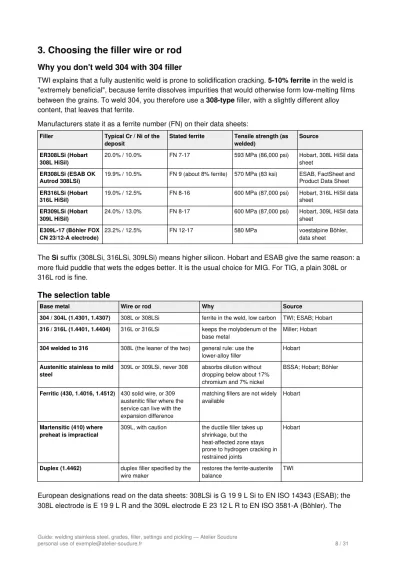
Preview
Real pages of the PDF (the buyer's email address is printed on the cover).
In pictures
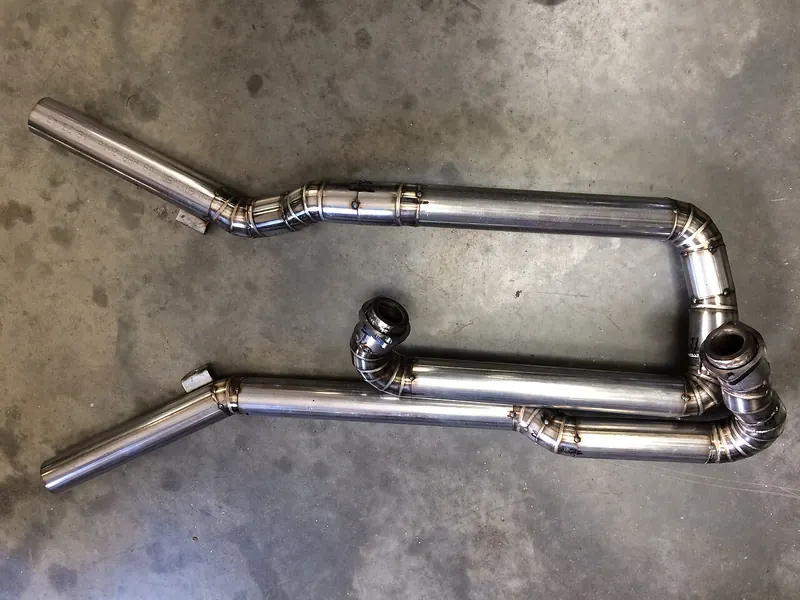
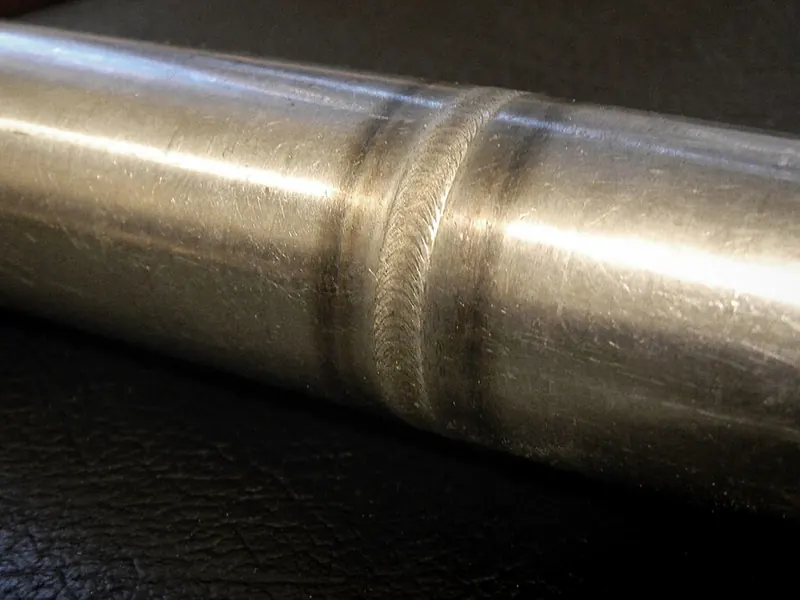
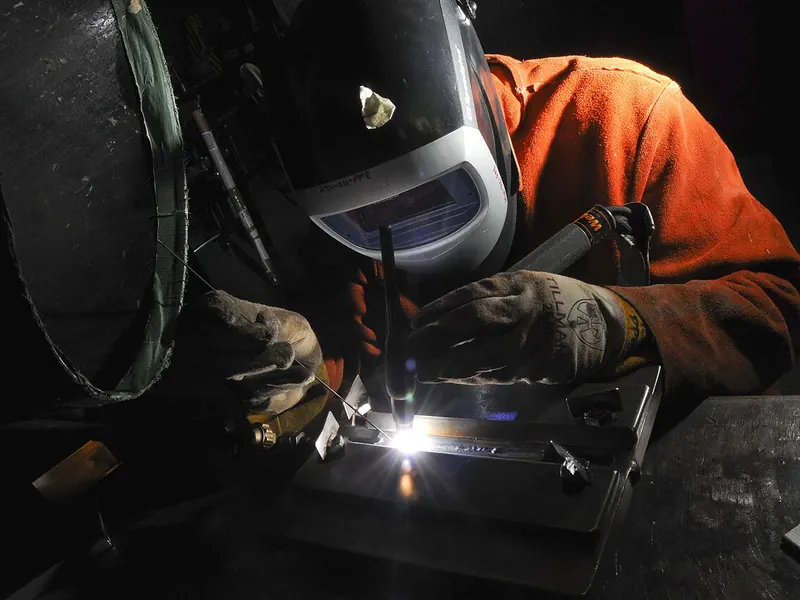
Illustrative photos, published by their authors under free licences.
What you get
- The grades you will meet (EN 10088-2:2024: 1.4301, 1.4307, 1.4401, 1.4404, 1.4016, 1.4512, 1.4462) with their 304, 316, 430 and 2205 equivalents, their physical properties, and what a magnet can and cannot tell you.
- Filler selection: 308L, 316L, 309L for stainless to mild steel, with ferrite and strength read from the makers' data sheets, and published currents for stick electrodes.
- Shielding on both sides: argon for TIG, low-CO2 MIG mixes, back purging.
- TIG and MIG settings from manufacturers, metric first with inches, cfh and ipm.
- Distortion, heat tint and pickling, with hydrofluoric acid first aid.
- A troubleshooting table, chromium VI and nickel in the fumes (with the OSHA limits), four worked cases (farm tank, boat rail, exhaust, stainless bracket on a steel frame), checklists and a wall chart.
Contents
- Before you start p. 4
What changes compared with mild steel - 1. Stainless steel families and grade names p. 5
Four families, four behaviors · The grades you will meet (EN 10088-2:2024) · The letter L: why low carbon matters · The physical properties that change how you weld - 2. Identifying an unknown stainless p. 7
What the magnet tells you, and what it doesn't · What the magnet will never tell you - 3. Choosing the filler wire or rod p. 8
Why you don't weld 304 with 304 filler · The selection table · Stick welding: the Böhler values - 4. Shielding gas: top side and back side p. 10
TIG: pure argon · MIG: little CO2, never a mild steel mix · Back side: back purging - 5. Preparation: cleanliness and dedicated tools p. 12
The principle: no iron on stainless · Before welding · Checking for free iron - 6. Setting up TIG p. 13
The setup · The typical AWS procedure reproduced by Hobart · CK Worldwide production values · Pulsed TIG for thin sheet · Technique in three points - 7. Setting up MIG p. 15
Equipment first · Short circuit: Hobart data sheets · Spray transfer: thicker work · ESAB ranges · Technique, from Miller - 8. Controlling distortion p. 17
Why stainless moves more · The countermeasures - 9. Reading heat tint p. 18
Where the colors come from · The sequence and what it means · What is acceptable for which use - 10. Pickling and passivating p. 19
Comparing methods · Products · Using a paste - 11. Troubleshooting p. 21
- 12. Welding stainless to mild steel p. 22
The rules · Corrosion between the two metals - 13. Fumes: hexavalent chromium and nickel p. 23
What stainless releases · The process makes the difference · Classification and US exposure limits · Controls - 14. Four worked cases p. 25
Case 1: stainless farm tank (water, effluent, washing) · Case 2: boat rail or non-structural decorative work in 316 · Case 3: stainless exhaust · Case 4: stainless bracket welded to a steel frame - 15. Checklists p. 26
Before buying · On welding day · Afterwards · Settings log - 16. The chart for the wall p. 27
- 17. Short glossary p. 28
- Sources p. 29
Contents read from the PDF that is sold (31 A4 pages), with the page number of each chapter.
Who it is for
Hobbyists with a TIG or MIG machine who want stainless welds that stay stainless, farmers repairing a stainless tank or wash trough, and apprentices moving on from mild steel.
What this guide is not
It is not a qualified welding procedure, and not a guide for pressure equipment, certified food-contact installations or structural parts: those belong with a qualified professional working to a written procedure.
Guide: welding stainless steel, grades, filler, settings and pickling — €24 incl. VAT
Stainless welds easily but loses its corrosion resistance through the wrong filler, heat tint left on, or contamination from carbon steel. This guide collects published values from TWI, BSSA, Hobart, ESAB, Böhler, Miller and OSHA to choose grade and filler, set up TIG and MIG, and pickle.